Rules checked: October 6, 2026
Trailing drawdown vs EOD drawdown comes down to timing. An intraday trailing drawdown moves up the moment your open profit hits a new high, while an end-of-day (EOD) drawdown only moves up once, after the session closes. A static drawdown never moves at all, which makes it the most forgiving of the three.
What Is Drawdown in a Prop Firm Account
In a prop firm account, the drawdown is the lowest balance you're allowed to reach. Firms call it different things – Topstep says Maximum Loss Limit, FTMO says Maximum Loss, Apex calls it a threshold – but it works the same way. Touch it and the account is done.
On a 50K futures account the drawdown is usually $2,000, so you start with a floor of $48,000. What changes between firms is whether that floor stays put or follows your profits up. That one detail decides how much room you really have, and it's why two accounts with the same "$2,000 drawdown" can feel completely different to trade.
One thing all three types share: the floor is checked in real time. Even with an EOD drawdown, Apex, Topstep and Tradeify all count open (unrealized) losses during the day. The difference is only in when the floor moves up.
Intraday Trailing Drawdown (Real-Time) with Example
An intraday trailing drawdown follows the highest balance your account reaches during the session, and that includes open profit. If a trade is up $900 for one minute, the floor moves up $900 in that minute. It never moves back down.
Here's a trailing drawdown example using Apex's own numbers. You start a 50K intraday account at $50,000 with a $2,000 drawdown, so the floor is $48,000. A trade runs to $900 in open profit, which takes the floor to $48,900. Then the market turns and you close at +$200.
Your balance is $50,200, but the floor stayed at $48,900. You made money and still lost $700 of room. On an EOD account, the same trade would leave the floor at $48,000 until the close.
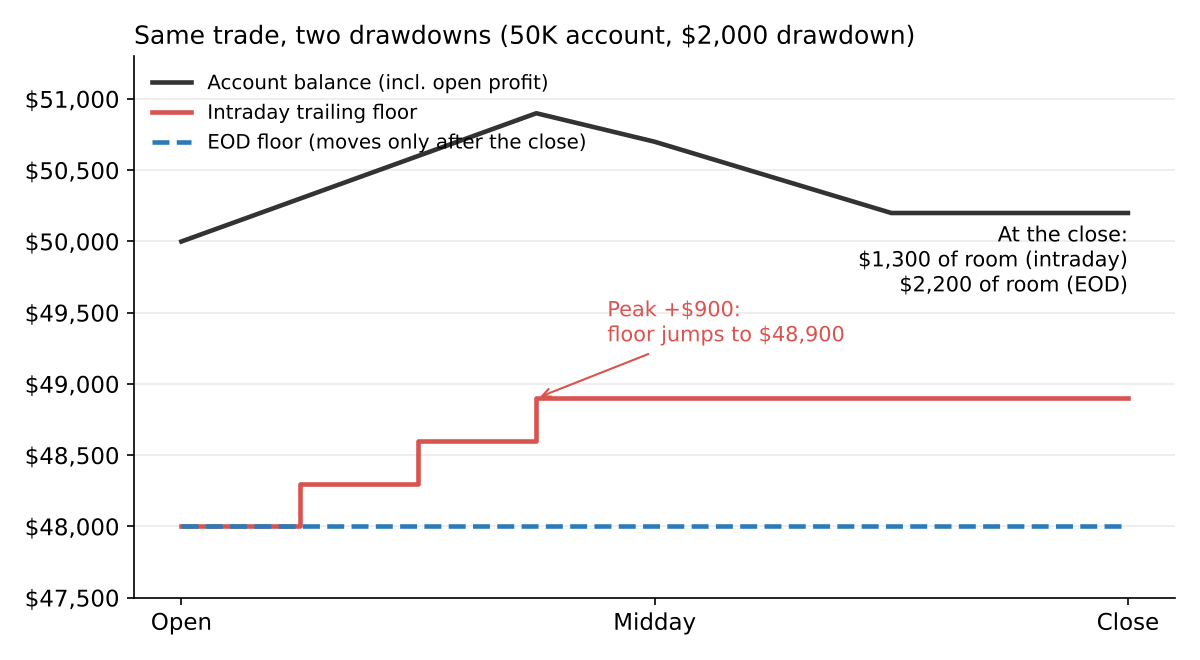
This is the trailing drawdown meaning most traders learn the hard way. It punishes trades that go well and then come back. Apex sells intraday accounts next to its EOD ones, and My Funded Futures has an intraday version of its Rapid plan, so check which one you're buying.
End-of-Day (EOD) Trailing Drawdown with Example
An end-of-day drawdown is calculated once a day, from your closing balance. Whatever your open profit did during the session doesn't matter for the floor. Only where you finish counts.
Apex gives this example for a 50K account with a $2,000 drawdown:
| Day | Closing balance | Floor for the next session |
|---|---|---|
| 1 | $50,800 | $48,800 |
| 2 | $51,600 | $49,600 |
| 3 | $50,900 | $49,600 (doesn't move down) |
| 4 | $52,000 | $50,000 |
The catch with end of day drawdown vs intraday is that "end of day" only describes when the floor moves. It doesn't describe when it's checked. Topstep, Tradeify and Apex all enforce the floor in real time, open losses included. Tradeify puts it plainly: the limit "only UPDATES at the end of each trading day, but it is ENFORCED continuously throughout the day".
An EOD account still fails on a bad trade. What it spares you is losing room on a good trade that gave some profit back.
Static Drawdown & When the Trail Locks
A static drawdown is a fixed floor. On an FTMO 2-Step account of $100,000, the maximum loss is 10%, so your equity can't drop below $90,000. Make $5,000 and the floor is still $90,000. FTMO's 1-Step uses an end-of-day trailing version of the same 10% instead.
None of the futures firms we checked use a static drawdown, but their trailing drawdowns stop trailing at some point. After that, they behave like a static floor:
- Apex Performance Accounts lock at your starting balance + $100, which is $50,100 on a 50K account.
- Tradeify funded accounts lock at $100 above the starting balance, or as soon as you request a payout.
- LucidFlex locks the floor at the starting balance + $100 once you pass the trail balance, and again when you request a payout.
- Topstep locks the Maximum Loss Limit once it reaches your starting balance.
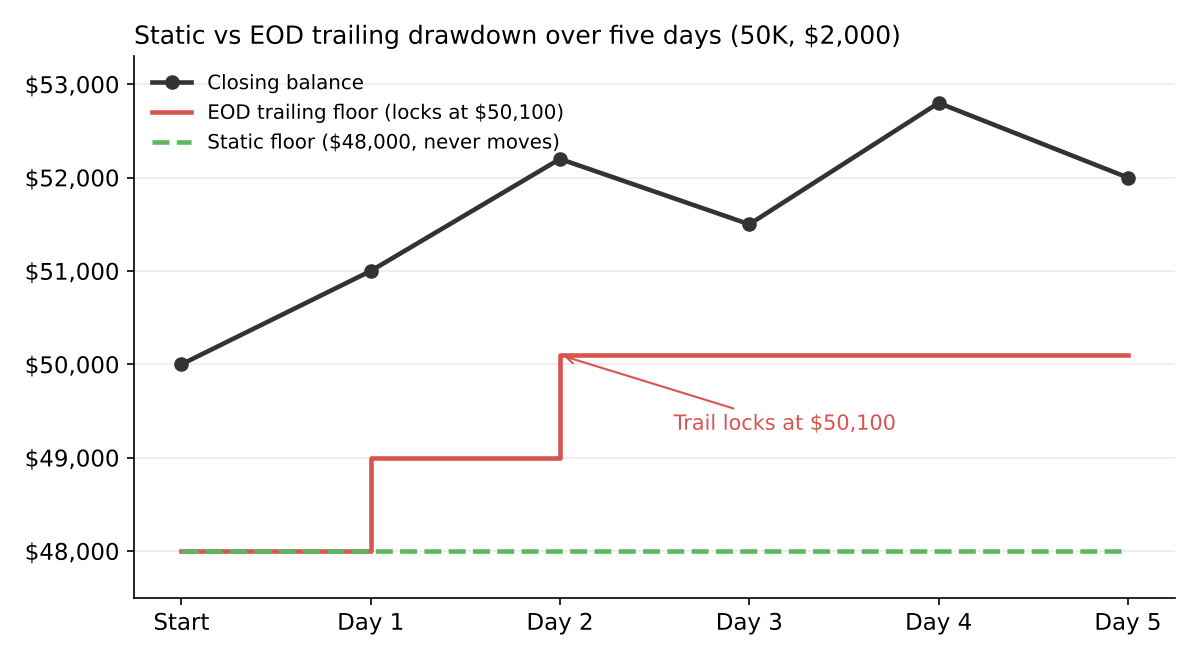
A static floor never leaves you less room than a trailing one. The trailing floor, though, stops costing you once it locks. On a 50K account that happens after about $2,100 of closing profit, and from then on the gap between the two stays fixed at $2,100.
Which Is Easier to Pass? Side-by-Side Scenarios
There's no single winner in trailing drawdown vs static drawdown – which is better depends on how your trades play out. Here are three common days on a 50K account with a $2,000 drawdown, starting fresh at $50,000.
| Scenario | Intraday trailing | EOD trailing | Static |
|---|---|---|---|
| Trade runs to +$900, you close at +$200 | Floor $48,900, room $1,300 | Floor $48,200 next day, room $2,000 | Floor $48,000, room $2,200 |
| Three steady days of +$400 | Floor $49,200, room $2,000 | Floor $49,200, room $2,000 | Floor $48,000, room $3,200 |
| Day 1 +$1,500, day 2 –$1,800 | Floor $49,500, balance $49,700, room $200 | Floor $49,500, balance $49,700, room $200 | Floor $48,000, room $1,700 |
The first row is where intraday hurts most. Open profit you never banked still raised your floor.
Steady days are a different story. If your trades go more or less straight to target, intraday and EOD end up in the same place.
The third row is the one that ends accounts. A big green day followed by a red one is survivable on a static account, but on a trailing account the first day already ate most of your room.
In our view, an EOD drawdown is the easier one to pass for most discretionary futures traders. Static is easier still, but among the futures firms we checked, nobody offers it.
Drawdown Type by Prop Firm
As of October 2026, this is what each firm's help center says. All numbers are for a 50K account (FTMO: $100,000).
| Firm and plan | Drawdown type | Size | Open P&L counts? | When it stops trailing |
|---|---|---|---|---|
| Apex EOD | End-of-day trailing | $2,000 | Yes, floor enforced in real time | PA: at $50,100 |
| Apex Intraday | Intraday trailing | $2,000 | Yes, also moves the floor | PA: at $50,100 |
| Topstep | End-of-day trailing (Maximum Loss Limit) | $2,000 | Yes | At the starting balance |
| Tradeify (all accounts) | End-of-day trailing | $2,000 | Yes | Funded: $100 above start, or on payout request |
| Lucid Trading LucidFlex | End-of-day trailing | $2,000 | Yes | At $50,100, or on payout request |
| My Funded Futures Rapid (sim funded) | Intraday trailing (EOD version also sold) | $2,000 | Yes, from the equity high | At $100 above start |
| FTMO 2-Step | Static | 10% ($10,000) | Yes, equity-based | Never trails |
| FTMO 1-Step | End-of-day trailing | 10% ($10,000) | Yes, equity-based | Doesn't lock; resets after a reward payout |
Two details are easy to miss. Apex evaluations on Tradovate keep trailing forever, while on Rithmic and WealthCharts the trail stops at the profit target balance. And at Topstep the Express Funded Account starts at a $0 balance, so its limit starts at –$2,000 and locks at $0.
From my experience: EOD drawdown suits me best, because the floor only moves after the session closes, not in real time. When unexpected news or a big move pushes my open profit up and then takes it back, the account doesn't lose any room. On an intraday account, that same spike would have raised my floor for good.
Verdict: which drawdown should you pick?
In our view, pick EOD over intraday if the firm gives you the choice. You lose nothing on trades that go straight to target, and you stop paying for open profit you never banked.
Each type has a downside, though. Intraday trailing punishes trades that run and come back. EOD trailing still checks your floor in real time, so a single bad trade can end the account just as fast. Static drawdowns are the most forgiving, but among the firms we checked only FTMO's 2-Step uses one, and it comes with a 5% daily loss limit on top.
FAQ
Does unrealized profit count toward trailing drawdown?
On an intraday trailing drawdown, yes. Apex says the peak balance "includes both realized and unrealized gains", so open profit moves the floor right away. On an EOD drawdown, open profit doesn't move the floor, but open losses still count against it during the day.
When does trailing drawdown stop trailing?
It depends on the firm. Apex, Tradeify and LucidFlex lock funded accounts at the starting balance + $100, and Topstep locks at the starting balance. Tradeify and LucidFlex also lock the floor as soon as you request a payout.
Is EOD drawdown better than intraday?
For most traders, yes. With the same $2,000 limit, EOD never gives you less room than intraday, and it gives you more whenever a trade runs and then comes back. It still won't protect you from a big open loss, because the floor is enforced in real time.
What happens to drawdown after a payout?
At Topstep, the Maximum Loss Limit on an Express Funded Account is set to $0 after your first payout. Tradeify and LucidFlex lock the floor at $100 above the starting balance when you request a payout. On FTMO 1-Step, the Maximum Loss Limit resets to 90% of the initial capital after you withdraw a reward.
Is FTMO drawdown based on balance or equity?
Equity. FTMO measures both the Maximum Loss and the Maximum Daily Loss on equity, which it defines as balance plus open profit or loss, plus or minus swaps, minus commissions. A floating loss can breach the limit even if you never close the trade.